Most Cambodians costume up casually besides when they’re attending formal occasions. It is not uncommon to see women and men utilizing Krama, a Lengthy, Slim checked cotton fabric spherical their neck. The krama is rather like a bit of clothes.
Light-weight, loose-fitting, cotton clothes is really helpful and long-sleeved gadgets needs to be included for defense from mosquitoes and the solar. In the course of the wet season, an umbrella is extra handy than a rain coast. A jacket could also be wanted in resorts and eating places utilizing extreme air-conditioning.
Textiles
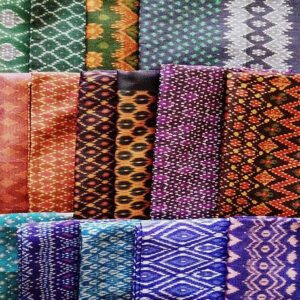 There are three essential silk textiles in Cambodia. They embrace the ikat silks (chong kiet in Khmer), or hol, the twill-patterned silks and the weft ikat textiles. Patterns are made by tying pure and artificial fibers on the weft threads after which it’s dyed. It’s repeated for various colours till the patterns agency and fabric is woven. Historically, 5 colours are used. Crimson, yellow, inexperienced, blue and black are probably the most used. The Sampot Hol is used as a decrease garment and because the Sampot chang Kben. The Pidan Hol is used as a ceremonial hanging used for non secular functions.
Sot silk weaving has been an essential a part of Cambodia’s cultural previous. It has been documented that individuals from Takéo Province have woven silk for the reason that Funan period and information, bas-relief and Zhou Daguan’s report have proven that looms have been used to weave sampots since historical occasions. Since historical occasions, girls have discovered extremely complicated strategies and complex patterns, one in every of which is the hol methodology. It entails dying patterns on silk earlier than weaving. What stays distinctive to Cambodian weavers is the uneven twill approach, the rationale stays unclear why they adopted such an uncommon methodology. The traditional bas-reliefs nonetheless gives a whole have a look at how materials have been like, all the way down to patterns and pleats. Silk woven items are used as heirlooms, in weddings and funerals, and as ornament in temples.
Sampot
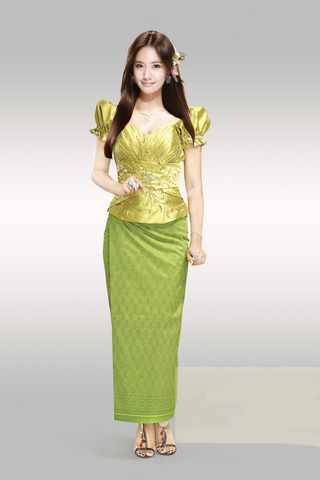 The sampot is the nationwide garment of Cambodia. The normal costume is just like these worn within the neighboring nations of Laos and Thailand, however variations do exist between the nations. The sampot dates again to the Funan period when a Cambodian king allegedly ordered the folks of his kingdom to put on the sampot on the request of Chinese language envoys.
There are various variations for the sampot, every is washed in accordance with social class. The standard sampot, recognized additionally because the sarong is usually worn by women and men of decrease class. It measures roughly one and a half meters and each ends are sewn collectively. It’s tied to securely safe it on the waist.
Kroma – Khmer Scarf
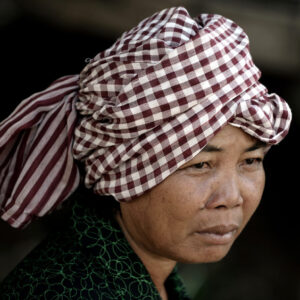 Beneath the nice and cozy Cambodian solar, an individual’s productiveness depends closely upon the suitability of 1’s costume. Since little is completed in blisteringly sizzling garments, Khmer folks for generations have tied kromas round their waists to work and play in cool consolation.
The Khmer scarf, woven from cotton or silk, has been a style staple since Historic occasions. Whereas some declare the skinny fabric, wrapped round one’s head or neck, is used primarily to wipe the sweat from a sizzling face, others say carrying a kroma is as ‘Khmer’ as carrying a necktie is American.Srey Yar Savdy, head of the Buddhist Institute’s Mores and Custom Division in Phnom Penh mentioned that the kroma has had a house in Cambodia for the reason that first century reign of Preah Tub Hun Tean. It isn’t clear when precisely the kroma hit the streets, however it has been an emblem of the Khmer kingdom and its folks ever since.
“These days, individuals are extra specific they usually prefer to have some high quality as a substitute of the cheaper kroma they used to make use of,” mentioned Channavy, the co-manager of a small weaving enterprise. She mentioned the calls for of discerning clients have compelled her to organize her loom with better care in an effort to meticulously spin the cotton thread right into a bobbin.